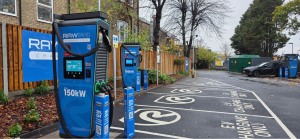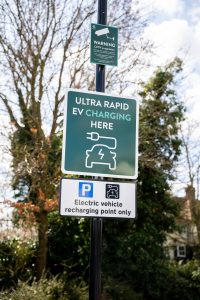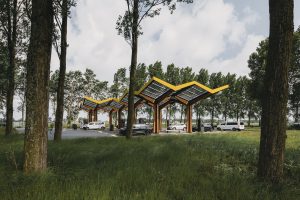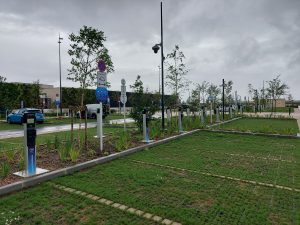
The EV charging market has stopped rewarding whoever builds fastest and started rewarding whoever builds best. The operators pulling ahead are making their sites profitable from day one, then rolling that same design out at pace.
Key takeaways
- Most public charging sites in Europe run at 10-20% utilisation, below the 16-20% a fast-charging site needs to break even.
- Slowing your rollout protects margins but leaves the network too small to compete. Building fast without profitability designed in forces costly, site-by-site retrofits later.
- EV charging site profitability is set at the design stage: location, sizing, driver experience, uptime, and revenue beyond the kWh.
- The operators winning do both at once. They get one site right, turn it into a repeatable blueprint, and replicate it at pace.
- Fastned grew to 406 stations while lifting revenue per site to €331,000, proof that scale and profitability come from the same discipline.
Kempower flagged something in their latest update that deserves every operator’s attention. Across Europe, charge point operators are focusing on the utilisation and profitability of the networks they already run, rather than accelerating expansion. It has pushed EV charging site profitability to the top of the agenda.
It’s an accurate read of where the market sits, and it’s usually taken as a choice. Keep expanding, or slow down and make what you’ve got pay. Both halves of that choice cost you.
Slow the rollout to protect margins and you end up with a network that turns a profit but stays too small to matter, while competitors take the sites you passed on. Push ahead without profitability designed in and you build a big estate you then have to go back and upgrade, site by site, which runs slower and far dearer than getting it right the first time. The operators who win refuse the choice. They get profitability, utilisation and ROI right in the design phase, lock it into a repeatable blueprint, and roll that blueprint out across locations. Build it profitable once. Repeat it everywhere.
Utilisation and profitability are now the priority
Operators are right to be looking hard at returns. Across much of Europe, public charging assets run at 10-20% utilisation, while a high-power site needs roughly 16-20% just to break even, according to analysis from Interpath. In the UK, ultra-rapid utilisation held around 12.8% through the back end of 2025 even as the network grew more than 13%, on Zapmap’s numbers. More chargers went in. Usage per charger barely moved. Capital has tightened since 2023, and investors now back the operators who can show strong site economics.
So the instinct to pump the brakes makes sense. But slowing down carries its own cost. Every quarter you ease off is ground a competitor takes, in a market that’s still growing and still deciding who owns which forecourt.
Where EV charging site profitability is decided
When a site underperforms, the cause usually sits upstream of the charger: the location, the product mix, the layout and driver flow, the lighting and safety, the uptime, and the revenue a site earns beyond the kWh. Every one of those is fixed at the design and rollout stage, long before a driver ever plugs in.
Getting the profitable version of a site right once gives you a template. A proven product mix, a proven layout, a known return. From there, each new site repeats a design that already works. Rollout turns into replication, and the risk was spent once, in the blueprint.
That is what lets pace and profit stop competing. You solve profitability at the design stage, then scale the answer. The operators who front-load that thinking get both at the same time: sites that pay from day one, stamped out quickly because the hard part is already done.
What makes an EV charging site profitable
Profitability at a charging site comes from a stack of decisions, and most are set before opening day.
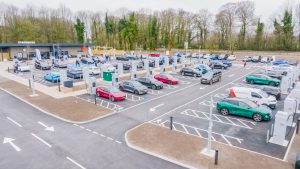
Location and sizing come first. A site on the right corridor, with the right number of chargers for the traffic it will genuinely see, avoids the two most common traps: too few stalls on a busy site, and a row of idle chargers on a quiet one. Both wreck the economics, and both are baked in the moment the site is planned.
Then the experience. Lighting, cover from the weather, clear signage, and a layout that feels safe and simple all decide whether a driver comes back or tries the site down the road next time. Repeat visits are what lift a site off the floor of that utilisation range, and they are won or lost on how the place feels at 9pm in the rain.
Then the revenue beyond the kWh. Amenities, retail, food and drink, advertising on canopies and signage: the additions that turn a charging stop into somewhere people choose and spend. On thin charging margins, this is often what tips a site from breaking even to genuinely paying, and it has to be planned into the layout from the start.
Get that stack right and you have a profitable site you can build again and again.
Retrofitting profitability is the expensive way
Retrofitting profitability into a live estate is the hard road. It means revisiting sites already built, reworking layouts, and adding the amenities, lighting or protection that should have been there on day one, often while the site is running and earning. The work costs more, takes longer, and disrupts the drivers you already have. Every operator now auditing an existing network for utilisation is paying that premium. Designing it in once, up front, is cheaper by a distance, and it is the only version that keeps pace with a rollout programme.
“I speak to operators every week who are looking at a network that impresses on a map and doesn’t pay. Almost always it traces back to the same thing: the sites went in fast, and the commercial thinking came afterwards. The ones quietly winning did it the other way round. They spent the time up front getting a single site genuinely right, the location, the mix, the experience, the extra revenue, then built that same site again and again. It costs less, it goes in quicker, and every location earns. I’d rather have that conversation before the ground breaks than two years after it.”
Vern Pollard, Director of Client Relations, Formula Space
Fastned: proof you can scale and stay profitable
Fastned added 60 stations in 2025 to reach 406 sites, and still lifted revenue per station to €331,000, up from €270,000 the year before. In the first quarter of 2026 that reached €387,000 on an annualised basis, at a 36% operational EBITDA margin. The network and the per-site economics grew together, because Fastned runs on prime locations held long term and stations sized for the traffic, the same profitable pattern repeated across nine countries. For them, expansion and profitability come from the same discipline.
Why the EV charging market is consolidating
The consolidation underway is part of the same story. Capital and scale are flowing to operators who can prove a site pays. InstaVolt passed 1,000 UK sites this year; Eviny and Mer merged to lead the Nordic market. Analysts expect each country to settle around a smaller group of strong operators over time. The bar has moved from how many chargers you can install to how well each one performs, and that plays to whoever builds with the economics in mind from the start.
How to build profitability in: the Formula Space method
This is where a single-source model earns its place, and it’s the process we run at Formula Space.
It starts in the Create phase, before anything is built. A brand and UX workshop, an agreed product mix signed off for the site, then site modelling and compliance checks with market feedback. That’s the stage where utilisation and revenue adders get designed in: the canopy, lighting, signage, amenities and layout that turn a site into somewhere drivers actively choose and come back to. Profitability guidance sits alongside it, so the commercial case for each site is clear before anyone breaks ground. That work produces the blueprint, the profitable site proven on paper before a spade goes in the ground.
Then the free-issue methodology replicates it. One design standard across every site, a single centrally issued product and design package, and everything above ground prepared, coordinated and supplied against the ICP programme. That single standard is the blueprint made real, so the economics that worked on the first site carry to the fiftieth. It also takes out the rework, the spiralling costs and the multi-supplier delays that slow most rollouts. Deployment runs around 30% faster, with one point of accountability rather than ten, and stock held on key components so long-lead items don’t stall the programme.
Then the Sustain phase keeps it performing: asset management, quarterly site reporting, and the data to show the economics are holding up.
The market’s move toward profitability is the right one. The operators who read it as a reason to slow down will end up with a network that pays but never scales. The ones who read it as a reason to build better will get both, because they solve the site once and repeat it at pace. Good expansion has profitability built into it. That work happens at the design stage, or it doesn’t happen at all.
Sources
- Kempower Half-Year update, July 2026: CEO commentary that operators are prioritising utilisation and profitability over network expansion.
- Interpath, European EV Charging, May 2026: 10-20% utilisation range against a 16-20% break-even threshold.
- Zapmap UK charging data, via Transport + Energy, May 2026: UK ultra-rapid utilisation ~12.8% in Q4 2025 while the network grew 13%+.
- Fastned FY2025 results (19 March 2026) and Q1 2026 results (16 April 2026): station count, revenue per station, operational EBITDA margin, multi-country network.
- Consolidation: InstaVolt/GeniePoint (June 2026), Eviny/Mer merger (July 2026), Chargalytics on market consolidation.
Formula Space designs and delivers EV charging infrastructure for operators, local authorities, and developers across the UK. We work with clients to make their sites identifiable, recognisable, and ready to scale. If a network rollout is on your roadmap and visual identity is part of the conversation, get in touch.