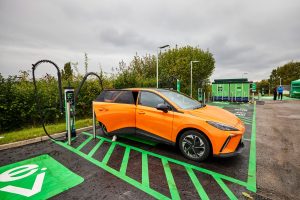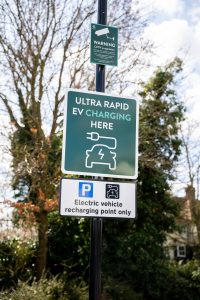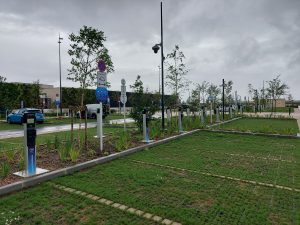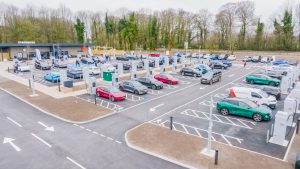
You can identify a Fastned site before you can read the signage.
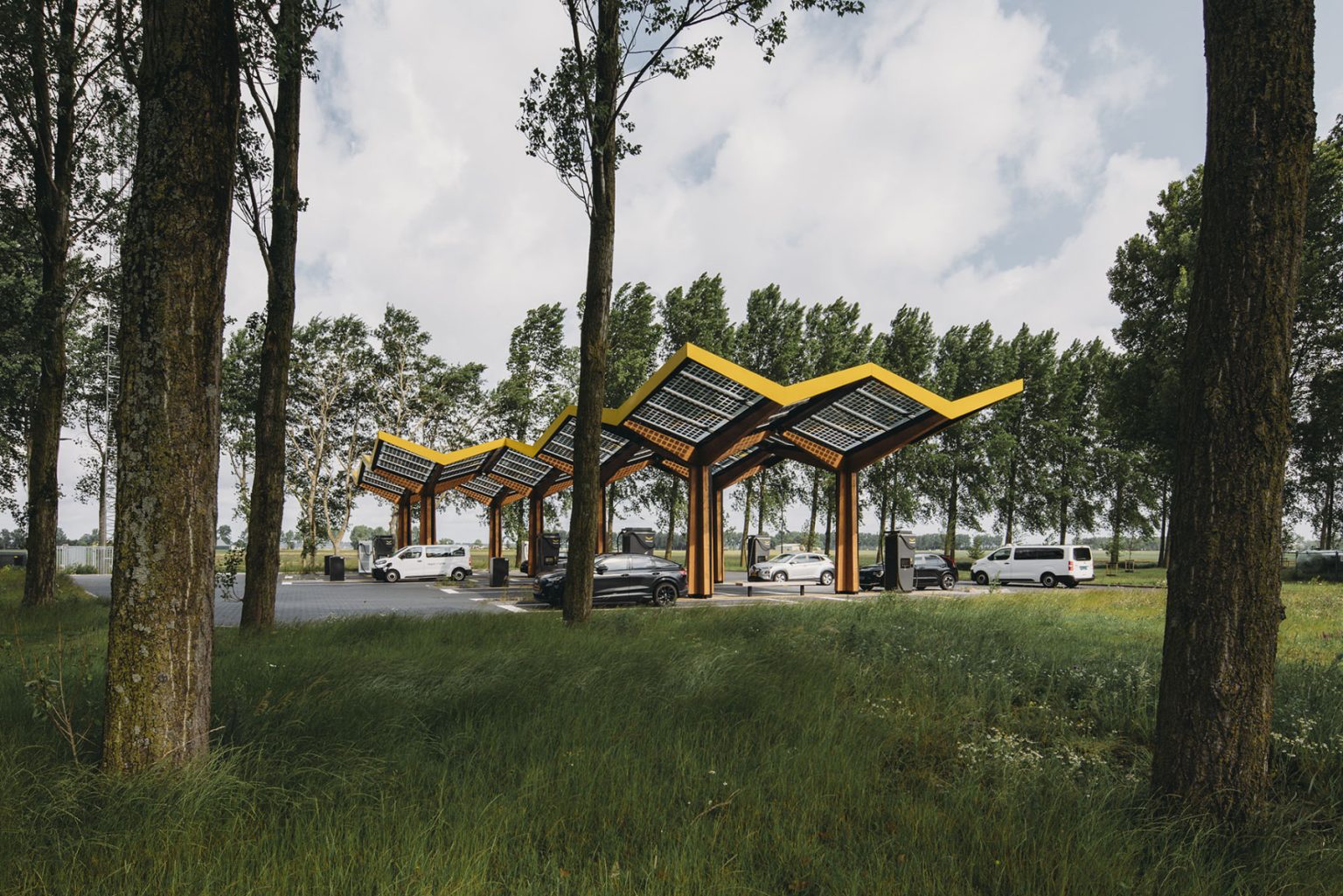
Drive past one on a motorway and the yellow Solar Tree canopy registers in less than a second. You don’t need to see the logo, the chargers, or the entry. The canopy alone tells you what you’re looking at and what to expect once you pull in. That recognition is doing real commercial work, and almost no UK CPO is matching it.
This piece looks at why Fastned’s canopy works as a brand asset, what the science behind it actually says, where the gap sits for UK operators in 2026, and what to do about it.
Why Fastned’s yellow canopy works as a brand asset
A brand asset is a visual or sensory cue that triggers brand recognition without needing the logo. Coca-Cola red. The Pringles tube. The McDonald’s arches. The Ehrenberg-Bass Institute, the marketing science group behind Byron Sharp’s How Brands Grow, calls these Distinctive Brand Assets. Decades of research back it up. Customers identify a brand in around 0.2 seconds from a distinctive asset, even on a distracted glance, even from peripheral vision.
The Fastned canopy is unique to the EV category. No other major European charging network has a comparable architectural element claimed as its own. It is also applied with absolute consistency. The geometry repeats and the yellow doesn’t shift. The structure scales but the design language doesn’t deviate.
And it works at distance. The vertical stem, horizontal canopy, and lighthouse signage column above it were all designed to be visible from the highway, before drivers reach the forecourt.
Zapmap, the UK’s most-used EV charging app, refers to Fastned in its 2025 driver satisfaction league table as “the network of distinctive yellow solar canopies.” A third-party data platform identifies the network by the canopy first, the brand name second.
What is a distinctive brand asset and why does it matter for EV charging?
A distinctive brand asset is any consistent sensory element that lets a customer recognise a brand without reading the name. In retail and FMCG the principle is well understood. In physical infrastructure like EV charging, it is scarcely applied.
A driver doing 60mph on the M25 has under three seconds to decide whether to take an exit. Recognition has to happen at distance, in peripheral vision, often through poor weather. The brain can’t read fine print at that speed. It can spot a colour and a shape.
Fragmentation makes this worse. The UK now has dozens of CPOs and counting. The 2025 LCP Delta survey found 93% of UK EV drivers are likely to repurchase from the same brand, the highest figure in Europe. Once a driver locks onto a network, they stay there. Operators who get spotted early get chosen repeatedly.
Most UK charging networks compete on charger speed, payment options, and reliability. Fastned competes on those plus a building drivers can identify before they slow down.
How Fastned built the Solar Tree
Fastned’s canopy is officially called the Solar Tree. It was developed by the company’s Location Design Director, María García Mansilla, and was named a finalist in the 2025 DesignEuropa Awards by the European Union Intellectual Property Office.
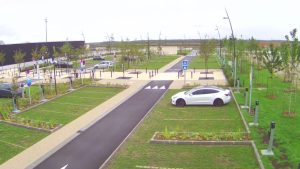
The design is built for function. A vertical timber stem supports a horizontal canopy clad in leaf-shaped solar panels that contribute to powering the site’s lighting and amenities. The yellow runs across the canopy edge, the chargers, and the bollards. A lighthouse signage column above the canopy is visible from the road before the canopy itself comes into view.
Fastned’s canopy is a full architectural template, protected, evolved, and rolled out at every new site for over a decade. Co-founders Bart Lubbers and Michiel Langezaal were explicit about the decision. They looked at petrol forecourts, judged the experience depressing, and set out to build a better one.
Fastned ended Q1 2026 with 414 stations across Europe, with more UK sites opening. Five London hubs are confirmed under the joint venture with Places for London at Hanger Lane, Canning Town, Hatton Cross, Tottenham Hale and Hillingdon Circus. New hubs opened in late 2025 near Newcastle Airport and at Sunderland. Aberdeen has approved a UK-first indoor 12-bay 400kW hub. Every site carries the same canopy.
Where do UK charge point operators stand on visual identity?
The desire is there, but execution across the entire estate is varied.
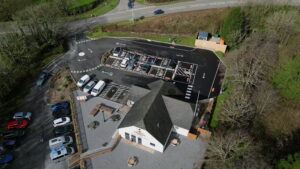
It could be argued Gridserve has the strongest architectural identity in the UK with its Electric Forecourts. The forecourts use a modular structure with green walls, considered lighting, and a clear visual language. The constraint is scale. Gridserve has fewer than ten Electric Forecourts versus its hundreds of high-power hubs, so the identity only applies at flagship locations.
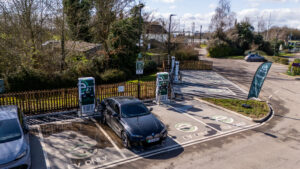
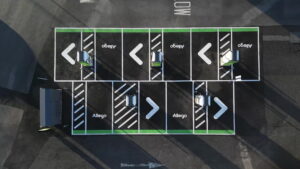
Be.EV is another operator that has invested in distinctive on-site design. Their flagship hubs use eco canopies with timber stems, paired with bay markings, signage and lighting that all sit in the same brand language. The full design has rolled out at select flagship sites rather than across the entire estate, which is a familiar position across the industry. Different site footprints, planning constraints and profitability considerations all influence which sites get the full treatment. The conversation often happens site-by-site rather than as a network-wide brand investment. Treating the canopy and visual system as a long-term brand asset, accumulating recognition with every install, opens a different internal case to treating it as a per-site cost.
Across the wider UK market, several operators are upgrading on-site elements to improve recognition. Logo and livery branding remain the foundation of any charging network’s identity and do real work at the point of use. The opportunity is in elevating that foundation with a distinctive architectural element drivers can spot before they reach the chargers themselves.
Tesla is arguably the closest UK comparison to Fastned. The red Supercharger pylons function as a distance cue, and Tesla won Zapmap’s Best Large Network in 2024 and 2025. The pylon does the same job as the Solar Tree on a smaller scale.
What other industries got distance recognition right
McDonald’s golden arches. Originally designed as 25-foot architectural elements positioned to be spotted a quarter-mile down the road. A Sponsorship Research International study across six countries found the arches were recognised by 88% of people, against 54% for the Christian cross. The arches do the work of the brand before any food, signage or staff become visible.
Shell’s pecten and yellow. A century-old colour-and-shape combination so consistently applied across every forecourt globally that drivers identify a Shell from over a mile away on an open road. The asset has barely changed since 1971.
Tesla’s red Supercharger pylons. Less bold than Fastned’s canopy, but applied with absolute consistency, and reinforced by Tesla’s ownership of the colour red across the vehicle, the app, and the charger. The pylon is the closest functional analogue to Fastned in the EV category.
The pattern across all three: pick a unique sensory element, apply it consistently for decades, and resist the urge to refresh it every few years. Sharp’s research on how brands grow puts this bluntly. Consistency over time, and uniqueness over salience. Those are the two rules.
What does this mean for UK charge point operators in 2026?
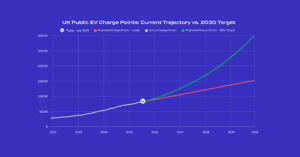
Over 80,000 public chargepoints are now installed across the UK (Zapmap, March 2026). At that scale, drivers can no longer remember which network they used last week. Operators that drivers can recognise without thinking get chosen more often than those competing on price, speed or reliability alone.
The site is the ad. A charging hub on a busy A-road or motorway service area gets seen by tens of thousands of drivers a week. If the building looks generic, that is tens of thousands of free impressions wasted. If it is distinctive, it becomes the cheapest brand-building media in the category.
Fastned has shown what claiming a yellow canopy looks like at scale. Tesla has done the same with red. The principle scales down too. A regional operator with twenty sites or a national one with two hundred can apply the same approach, just with a different element.
How to apply this without copying Fastned
Copying Fastned’s yellow canopy would destroy its value. Fastned has earned that asset through a decade of consistency. The principle behind it can travel to any UK operator willing to claim their own design language. Four practical steps, all simple to describe and hard to follow through.
Start with the silhouette. Identify the one architectural element a driver can recognise from 200 metres. Pick it before you pick the colour, the materials, or the chargers.
Make it ownable. Audit the category. If the element exists elsewhere, including in adjacent sectors like petrol forecourts or supermarket fuel, change it.
Apply it without compromise. The asset has to appear on every site to work, including the smaller and harder-to-deliver ones. Drivers learn through repetition.
Defend it for a decade. Distinctive brand assets get stronger the longer they stay the same. Refreshing them every couple of years restarts the clock.
Most UK charging operators will spend 2026 fighting for visibility on Zapmap, in app stores, and on Google. The ones who think bigger will be fighting for visibility in the rear-view mirror.
Fastned spent over a decade proving this works. UK operators don’t need to start that experiment again. They just need to pick their element and commit.
Sources
- Fastned’s Solar Tree design named finalist in DesignEuropa Industry award — EUIPO
- Best EV charging networks UK 2025: Zapmap driver satisfaction rankings
- European EV drivers show strong brand loyalty — LCP Delta 2025 survey
- Fastned and Places for London get green light for EV charging hub in west London — TfL
- Fastned accelerates UK expansion with new ultra-rapid charging hubs in the North East
- Fastned moves forward ‘UK-first’ indoor EV charging hub — EV Infrastructure News
- Fastned sells over 55 GWh of electricity in first quarter — electrive.com
- Fastned Keeps Redefining What A Charging Station Can Look Like — CleanTechnica
- Fastned’s Solar Trees: Nature-Inspired Infrastructure for EV Charging — MaterialDistrict
- The distinctive asset in the room — Ehrenberg-Bass Institute for Marketing Science
- Building Distinctive Brand Assets — Your Marketing Rules (Byron Sharp summary)
- GRIDSERVE Electric Forecourts — Arup architects collaboration
- GRIDSERVE Electric Forecourt design — The Splash Lab (Bisset Adam architects)
- BP launches new format EV charging hub — Transport and Energy
- The complete history of McDonald’s Golden Arches logo design — The Logo Creative
- McDonald’s golden arches more globally recognisable than the cross — The Fact Base (Sponsorship Research International)
- Tesla and Sainsbury’s Smart Charge top Zapmap ratings — Transport and Energy
Formula Space designs and delivers EV charging infrastructure for operators, local authorities, and developers across the UK. We work with clients to make their sites identifiable, recognisable, and ready to scale. If a network rollout is on your roadmap and visual identity is part of the conversation, get in touch.